

When people discuss the classic texts that define our current moment in artificial intelligence, the usual suspects always crop up. You’ll hear about Ray Kurzweil’s The Singularity Is Near, predicting our merger with machines, or Nick Bostrom’s Superintelligence, warning of the existential risks of powerful AI. These are important books, certainly. But I’ve found that two other books — neither of which is usually considered a classic AI text — have done far more to shape my understanding of where we are and where we’re going.
They might not be the obvious choices, but I reckon they are essential reading for anyone trying to make sense of the current moment.
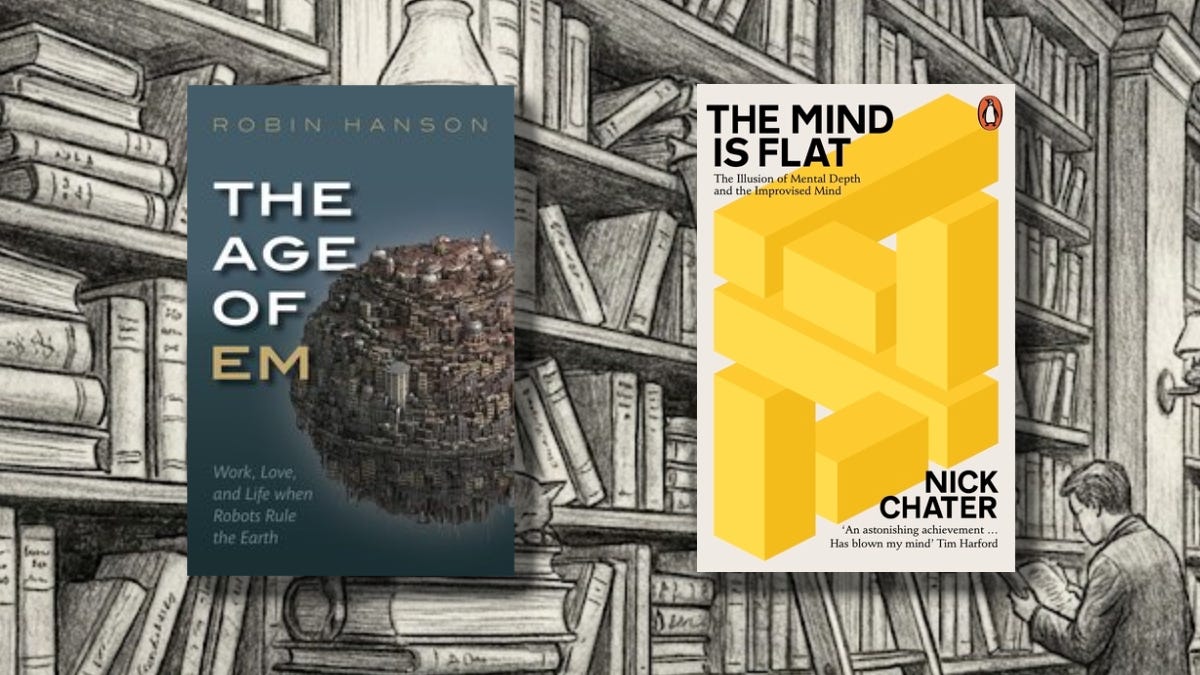
The Economics of Brain Emulation
The first recommendation is The Age of Em by Robin Hanson.
Hanson published this book in 2016, just as deep learning was gaining traction but well before the large language model explosion. His premise is: instead of a superintelligence constructed from new machine learning algorithms, imagine a future where we simply emulate human brains in silicon. These “Ems” (emulators) aren’t alien gods; they are copy-paste versions of human minds, running on fast hardware.
The book is a strange beast. It is technically speculative fiction, but it is not a novel. Instead, Hanson writes it like an economics textbook beamed back from the future. He consistently applies the principles of physics and economics to this hypothetical world.
What happens to wages when you can copy a worker a thousand times? What does retirement look like when you can run a simulation of yourself at 100x speed?
While our current path — building powerful intelligence from scratch via transformers — looks different from Hanson’s brain emulation scenario, the logic of his arguments is still relevant. We are entering an era where intelligence is becoming a commodity: cheap, copyable, and deployable at scale. Hanson’s analysis of armies of cloned brains operating the economy might be the best mental model we have for a future of millions of autonomous AI agents. He teaches us to think about the constraints on technology — energy, bandwidth, physical space — rather than just the magic of it.
What Minds are Really Like
My second pick is The Mind Is Flat by Nick Chater.
Chater, a Professor of Behavioural Science, published this in 2018. It is a book about psychology and cognitive science, and does not mention Generative AI. Although it was published just as that technology was starting to work, the book is unrelated. Yet, the mind it describes sounds a lot like a large language model.
We tend to believe that our minds have immense depth — that beneath our conscious thoughts lies a vast reservoir of memories, beliefs, motives, and stable personality traits. Chater argues that this is a spectacular illusion. He presents a wealth of empirical evidence to suggest that the mind is actually a serial generative device. We don’t excavate deep truths from our subconscious; we generate and improvise thoughts on the fly, moment by moment (if not token by token).
In other words, the human mind Chater presents to us is not all that different from a large language model, and there’s plenty of evidence to suggest that this is indeed the mind we all possess.
When critics say that AI is “just a stochastic parrot” or “merely predicting the next word”, they often imply that human cognition is something far more profound. Chater demonstrates the uncomfortable opposite: we are all stochastic parrots. The mental depth we imagine is a trick of the light. Understanding this not only demystifys the human mind, it also helps us appreciate that an improvising, surface-level intelligence can still be incredibly powerful and creative.