

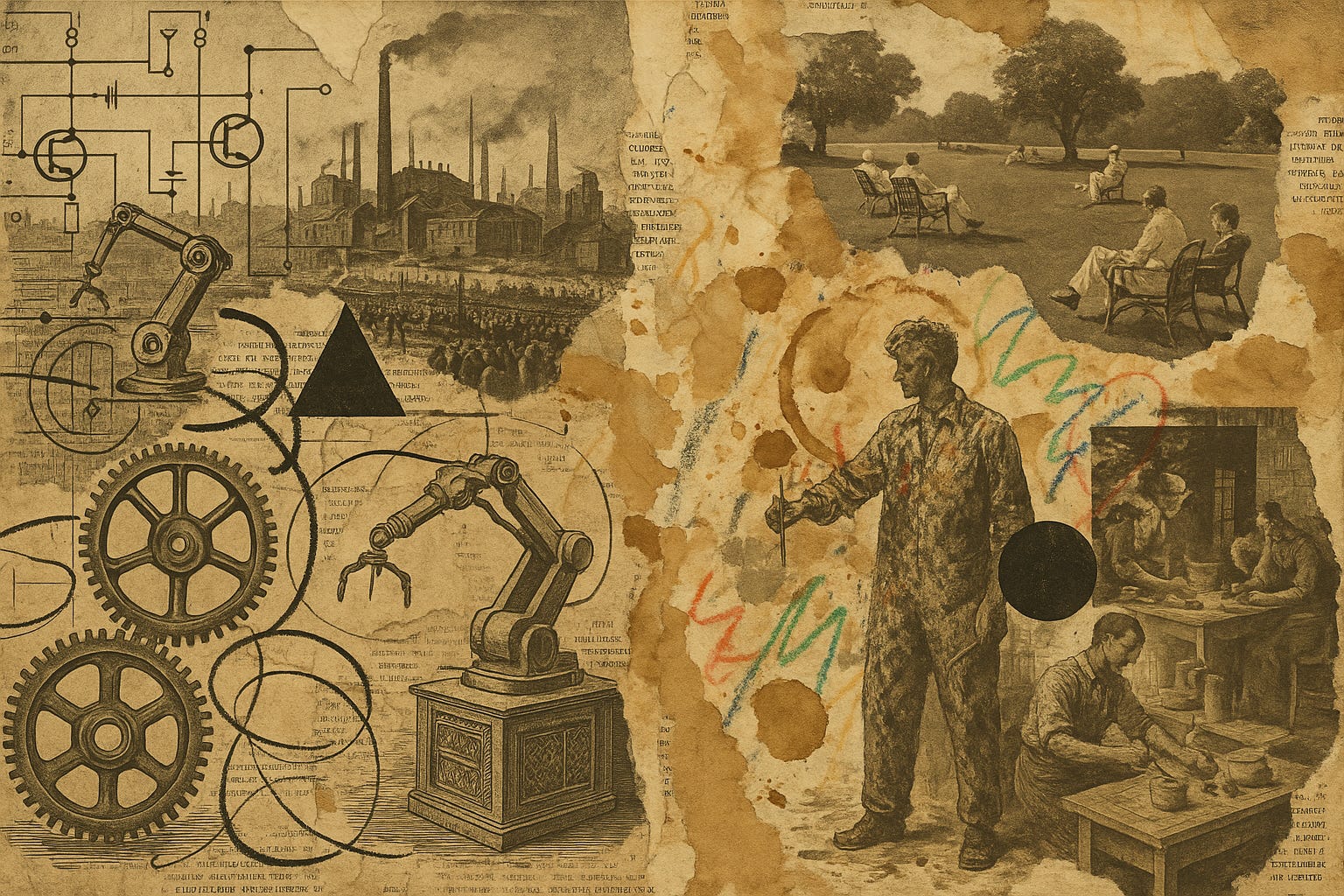
One is the proverbial “country of geniuses in a datacentre”: the AI Industrial Economy. The other is where we live: humanity. The future we are racing towards will be defined by these two economies existing side by side: the AI Industrial Economy and the “country club economy” of us and for us.
So much of the current chatter about AI’s impact on jobs and productivity misses the mark. It tends to obsess over the messy, short-term transition we’re in right now. Experts debate whether AI is destroying jobs or creating new ones, or how much it’s really boosting productivity.
The problem with these discussions is how they ignore the exponential pace of AI improvement. They look at what happened last year or over the last decade and extrapolate, assuming progress will continue at a similar rate. But if you look closely, AI progress isn’t just moving forward; it’s accelerating.
If we take this acceleration seriously, we have to accept that within a few years, AI will be powerful enough to handle all cognitive work better and cheaper than any human. Soon after, it will master the physical world through robotics. Once you accept that premise, the endless debates about today’s job market seem a bit beside the point. Who cares what colour is your collar when we are all equally inferior to AI, at least as far as productive economic activity goes.
The AI Industrial Economy will be operated almost entirely by technology — very powerful artificial intelligence (call it AGI or superintelligence if you like). It will have “embassies” all over the planet in the form of datacentres and robotics, and eventually, it will expand throughout the universe.
The human economy remains the one we know today. Our economy won’t really have a role in the AI Industrial one. There is nothing we can contribute to a superintelligent system other than setting it in motion and ensuring it’s aligned with our well-being. If we manage that successfully, the human economy will become a tiny, disconnected island floating alongside the massive AI economy.
Some of us might choose to live like retirees, enjoying a life of pure leisure — spending our days at the country club. Others will find purpose and meaning in activities that look like work: offering services to one another, creating art, or making artisanal goods to sell to other humans. This activity won’t be needed for survival; it will be for fun, creativity, and purpose.
When we worry about displacement, we imagine powerful AI emerging as a force and breaking our current economy – taking our jobs, automating us out of economic viability. A better way to think about it is that a new, alien economy is growing alongside ours. All to our benefit.